
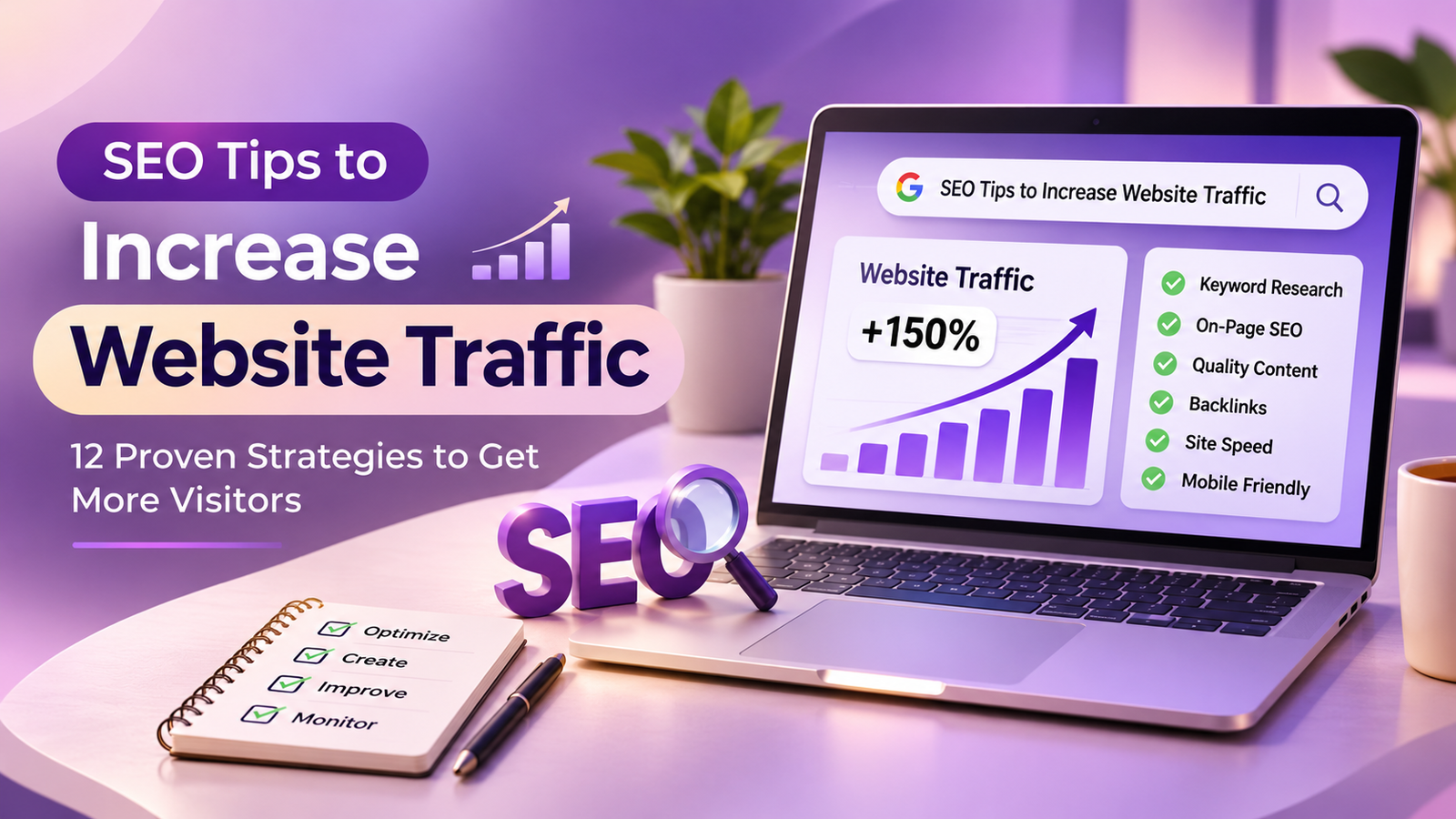
Getting traffic to your website is essential for building an online presence, attracting potential customers, and growing your business. However, simply having a website is not enough. You need the right SEO strategies to increase website traffic and make sure your target audience can find you on search engines like Google.
Search Engine Optimization (SEO) helps improve your website's visibility in search results, attract relevant visitors, and generate more business opportunities without depending entirely on paid advertising.
Whether you own a small business, run an eCommerce store, or manage a corporate website, these 12 SEO tips can help you increase organic website traffic and improve your online visibility.
1. Find and Use the Right SEO Keywords
Keywords are the foundation of every successful SEO strategy. They help search engines understand your website content and connect it with relevant searches.
Start by researching keywords that your potential customers are searching for.
Tips:
Use tools like Google Keyword Planner, Google Search Console, and Google Trends.
Focus on relevant keywords with good search intent.
Include primary and secondary keywords naturally in your content.
Target long-tail keywords to reach a more specific audience.
For example, instead of targeting only "web development", consider keywords like "website development services for small businesses".
2. Publish High-Quality and Helpful Content
Content plays an important role in improving website rankings and attracting organic visitors.
Create informative content that answers your audience's questions and solves their problems.
Consider publishing:
Informative blog posts and industry guides.
How-to articles and tutorials.
Frequently asked questions (FAQs).
Product and service-related content.
Industry news and updates.
Focus on providing genuine value instead of repeating keywords unnecessarily.
3. Optimize Your Website for On-Page SEO
On-page SEO helps search engines understand your website pages and their relevance to specific searches.
Make sure every important page is properly optimized.
Important on-page SEO elements:
SEO-friendly page titles.
Unique meta descriptions.
Proper H1, H2, and H3 heading structure.
Relevant keywords in headings and content.
Descriptive image alt text.
SEO-friendly URLs.
Internal links between related pages.
A well-optimized page improves content accessibility and makes it easier for search engines to understand your website.
4. Improve Website Loading Speed
Website speed directly affects user experience. Visitors are more likely to leave a website if it takes too long to load.
A faster website can also support better search performance.
Ways to improve website speed:
Compress images without compromising quality.
Use modern image formats like WebP.
Enable browser caching.
Minimize unnecessary CSS and JavaScript.
Choose reliable web hosting.
Use a Content Delivery Network (CDN).
Test your website using Google PageSpeed Insights to identify performance issues.
5. Make Your Website Mobile-Friendly
Most users browse websites through smartphones. Therefore, having a mobile-friendly website is essential.
A responsive website automatically adjusts its layout to different screen sizes, providing a smooth browsing experience.
Ensure that:
Text is easy to read on mobile devices.
Buttons and links are easy to tap.
Images fit properly on smaller screens.
Navigation menus work correctly.
Pages load quickly on mobile networks.
Google primarily uses the mobile version of website content for indexing and ranking.
6. Build Quality Backlinks
Backlinks are links from other websites that point to your website. Quality backlinks can help establish your website's authority and credibility.
Focus on earning relevant links from trustworthy websites.
Effective backlink strategies:
Write guest posts for relevant websites.
Submit your business to genuine industry directories.
Publish original research and useful resources.
Collaborate with industry-related websites.
Create shareable infographics and guides.
Avoid buying spammy backlinks or participating in link schemes, as these can negatively affect your SEO performance.
7. Use Internal Linking Strategically
Internal links connect different pages within your website. They help visitors discover related information and allow search engines to understand your website structure.
For example, if you publish a blog about SEO strategies, you can link to your website development, digital marketing, or SEO service pages where relevant.
Use descriptive anchor text and link only to relevant pages.
8. Optimize Images for Search Engines
Images improve the visual experience of your website, but unoptimized images can slow down page loading.
Image SEO can also help your content appear in Google Images.
Follow these practices:
Use descriptive image file names.
Add relevant alt text.
Compress large image files.
Use WebP or other suitable modern formats.
Choose appropriate image dimensions.
Avoid unnecessary decorative images.
9. Focus on Local SEO
If you operate a business that serves customers in a particular location, local SEO can help you attract nearby customers.
For example, a website development company in Mumbai can optimize its website for location-based searches.
Local SEO tips:
Create and optimize your Google Business Profile.
Keep your business name, address, and phone number consistent.
Add accurate business information.
Collect genuine customer reviews.
Create location-specific service pages.
Publish relevant local content.
Local SEO helps your business become more visible when potential customers search for services in your area.
10. Optimize Your Website for User Experience (UX)
Getting visitors to your website is only the first step. You also need to provide an experience that encourages them to explore your pages.
A good user experience makes it easier for visitors to find the information they need.
Improve your website UX by:
Using simple and clear navigation.
Maintaining consistent design elements.
Adding clear call-to-action buttons.
Avoiding intrusive pop-ups.
Organizing information into readable sections.
Fixing broken links and confusing layouts.
A user-friendly website can help increase engagement and improve conversions.
11. Regularly Update Old Website Content
Publishing new content is important, but updating existing pages is equally valuable.
Outdated information can reduce content usefulness and affect visitor trust.
Review your existing blogs and website pages regularly.
Update:
Outdated statistics and information.
Broken links.
Old screenshots and images.
Irrelevant keywords.
Missing information.
Outdated product or service details.
Add new insights and improve content wherever necessary to keep it relevant and helpful.
12. Track Website Traffic and SEO Performance
SEO is an ongoing process. You need to monitor your performance to understand which strategies are working.
Use these free Google tools:
Google Analytics 4 (GA4): Track website visitors, traffic sources, engagement, and conversions.
Google Search Console: Monitor search impressions, clicks, keyword performance, indexing issues, and search visibility.
Review your results regularly and identify opportunities to improve underperforming pages.
How Long Does It Take to Increase Website Traffic Through SEO?
SEO is a long-term strategy, not an overnight solution. The time required to see noticeable improvements depends on your website's current condition, competition, content quality, backlinks, and SEO efforts.
Some improvements may appear within a few weeks, while achieving meaningful organic traffic growth often takes several months.
Consistency, quality content, and regular optimization are key to long-term results.
Conclusion
Increasing website traffic requires more than publishing content or adding keywords. A successful SEO strategy combines keyword research, quality content, technical optimization, mobile responsiveness, backlinks, and a positive user experience.
By implementing these 12 SEO tips consistently, you can improve your website's search visibility, attract relevant visitors, and create more opportunities for business growth.
Want to Grow Your Business Online?
A professionally designed and SEO-optimized website can make a significant difference in your online growth. At Padma Computech, we help businesses build professional websites that focus on performance, user experience, and online visibility.
Get in touch with our team to discuss your website development and digital growth requirements.